
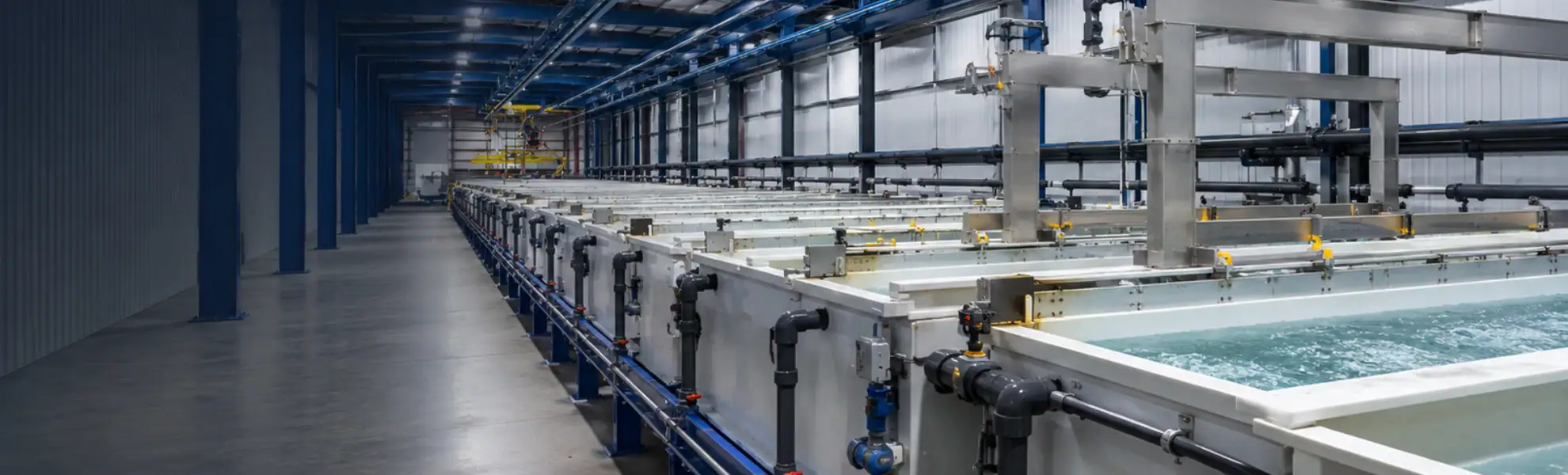
Post-processing ensures finished components meet both functional and cosmetic requirements before they reach the customer. Depending on the application, that can include anodizing, assembly and testing, grinding, heat treating, plating, and other secondary operations — helping every part keep the precision, consistency, and reliability our customers expect while cutting the handoffs, transport delays, and vendor gaps that slow multi-supplier workflows.
Read more about our post-processing operationsShow less
Anodizing
An electrochemical process that transforms the part’s surface into a hardened, corrosion-resistant oxide layer — not a coating that sits on top. We work across Type I (chromic acid), Type II (sulfuric, including popular black anodize), and Type III (hardcoat) to improve wear resistance, appearance, and durability on fittings, housings, spacers, connectors, and valve components held to tight tolerances.
Assembly & Testing
We bring machined components together into finished subassemblies — press-fitting, staking, threading, fastening, and sealing — then verify them with leak, pressure, torque, dimensional, and automated vision testing. Parts arrive ready to use and proven to perform, reducing your internal labor and supply-chain complexity.
Grinding
Precision grinding brings critical features such as bearing surfaces, shafts, pins, and mating diameters to exacting tolerances and superior finishes. Centerless, cylindrical, surface, and internal grinding refine concentricity, roundness, and surface quality — especially after heat treat, where it restores precision lost to thermal distortion.
Heat Treating
Controlled heating and cooling tune a part’s hardness, strength, and wear resistance — through hardening, tempering, case hardening / carburizing, annealing, and stress relieving. Tight process control holds dimensional accuracy on high-tolerance screw machine parts so they perform under friction, stress, impact, and high load.
Plating
Thin metallic coatings that protect and enhance the part — zinc, nickel, electroless nickel, tin, silver, and gold plating, plus passivation for stainless. Plating improves corrosion resistance, conductivity, solderability, lubricity, and appearance, and is often a compliance requirement across electrical, aerospace, and industrial applications.